Life COMET toolkit for Community Energy Service Points
- Preparation
- Implementation
- Financial
- Staff & organisation
- Technical
- Europe
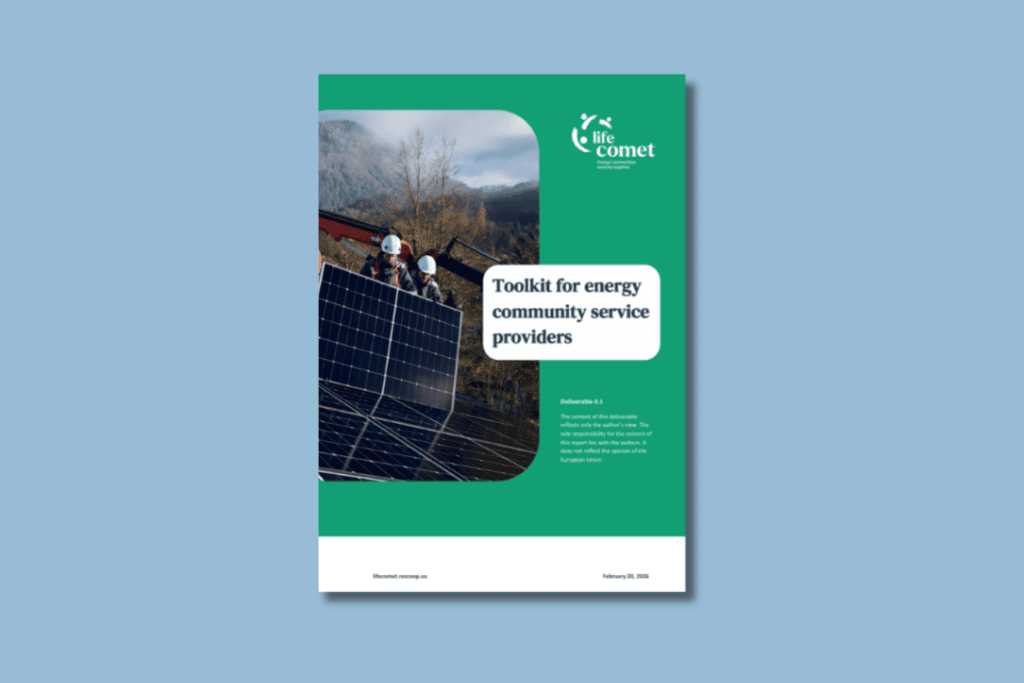
This document is an indicative and operational toolkit developed to support the implementation of Community Energy Service Points (CESPs).
Community Energy Service Points emerge as a response to persistent structural barriers that prevent citizens and local initiatives from translating interest in renewable energy into operational projects. Across multiple EU countries, fragmented information, unclear procedures, limited access to impartial expertise, and weak coordination between public authorities and market actors create a high threshold for engagement. While individual pilot projects may succeed under favourable conditions or external funding, the absence of a stable support structure results in low replication, slow learning, and limited market formation. CESPs address this gap by acting as institutional intermediaries between citizens, public authorities, and the energy market. Their role is not limited to providing information or consultancy, but to systematically reduce complexity, de-risk early-stage initiatives, and enable consistent pathways from idea to implementation. In this sense, CESPs function as enabling infrastructure rather than isolated service providers.
This toolkit was developed within the framework of the Life COMET project. Its primary purpose is to help organisations design, launch, and operate CESPs that effectively lower barriers for citizen-led energy initiatives, accelerate the uptake of energy communities, and enable energy sharing schemes across different national contexts.
It provides concrete steps, decision rules, checklists, templates, and service design tools that reflect real-life constraints, emerging markets, and varying levels of institutional maturity. Rather than prescribing a single model, the document offers modular building blocks that can be adapted to local regulatory, market, and organisational conditions.
The toolkit is intended for:
- organisations establishing a CESP for the first time or expanding support services,
- existing service providers scaling or professionalising their support for energy communities.
The document combines three layers:
- A way of thinking about CESPs as operational systems (strategy, positioning, decision-making),
- Hands-on operational guidance for setting up and running services,
- Practical tools and templates that can be directly applied in daily work.
The toolkit is modular by design. Not all CESPs need all services, and not all services should be delivered from day one. To support this, the document is structured around a CESP lifecycle logic and a Minimum Viable Operative System (MVOS) approach, helping readers distinguish between what is essential, what can be added later, and what may not be required in each context.

Explore related resources


Questions about your energy community?
Whether you don’t know where to start from or you are stuck with a specific issue in the development of your energy community, an expert can help you.
