Community energy: A practical guide to reclaiming power
The Life of Your Group
Building up your team
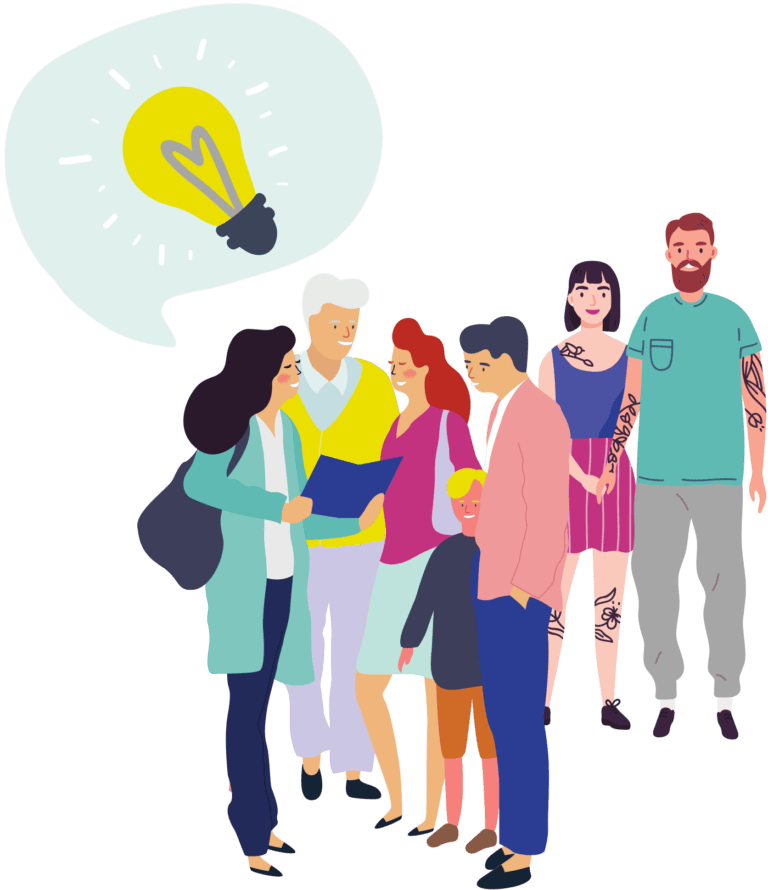
Community energy projects always need more people like you with fresh energy and good ideas to get involved and help take the project forward.
Maybe something is already happening in your area that you can get involved in. You could help your existing local energy company branch out into a new activity, such as wind or electricity supply. Or maybe you could start with an existing community group that might be interested but hasn’t got involved in local energy. It’s always easier to join something established, with existing resources, rather than start from scratch yourself. It’s possible that a very small group exists without you knowing, so make sure to thoroughly research what might be going on already!
If there isn’t anything going on, things depend on you. The biggest community energy projects start from small meetings and small conversations. Ecopower, one of Europe’s biggest energy cooperatives, started with a conversation around the kitchen table in a watermill. Take the first step. Even if it’s just one or two people in your community who might be interested, meet them for lunch or coffee to chat about your ideas.
Start small, grow big
Community energy initiatives come in many different shapes and sizes, and are in fact as diverse as communities themselves. Some are relatively small, have fewer members and pursue only small-scale renewable energy projects (typically solar panels) or energy sharing schemes. There are also extremely large energy cooperatives such as Ecopower (Belgium), which as of 2019 had almost 60,000 members, owned 22 wind turbines, 3 hydropower installations, 322 solar installations, one cogeneration installation using rape seed oil and a wood-pellet factory.
Experience shows it’s easier to convince wider members once your first project is up and running, or when members are given the opportunity to use the energy directly. Momentum builds on itself. When people see the project’s success, they want to get involved. Often projects struggle to sell shares in their first share offer, but then when they start to build infrastructure, the next share offer is oversubscribed. People are naturally more likely to invest their money when they see a project has a track record.
Even if you have very big plans, for multiple wind projects for example, it’s always good to start small. You could start with solar panels on a school, or with an energy saving programme in a neighbourhood. These projects won’t necessarily be easy, but they will help you build up the trust and recognition you need to grow into something bigger, like a wind project or grid ownership.
Building together
An important principle to bear in mind throughout this process is to be flexible with your ideas. You need to strike a balance between having an inspiring idea and being open-minded, to be able to adapt to what others want to do, find out what gets them inspired and excited. Strike this balance and you are on the road to success!
Ask them what their ideas are, what their vision is. Make sure you are actively listening as much as you are talking: you want to grow ideas together. Have a pen and a piece of paper handy, and don’t be afraid to start scribbling or drawing together. Get excited!
You could also discuss who else in the community might like to get involved. Who do you know who gets things done? Who takes responsibility in your community? Write down a list of people you would like to contact about your ideas. Be aware you don’t just need retired, grey-haired male engineers, but a diverse group of volunteers who can bring different skills, connections and ideas to the table. Always agree on next steps together at the end of each meeting.
Your core team
Ideally you are looking to build up a core group of people who will share responsibility for the project over the long term. This could be from 4-12 people, but the more you have in your inner team the better.
You will want people in your core team to like each other! You need to build up strong trust relationships so that you can all support each other and show leadership in the project. It’s also good practice to make sure you and your team provide each other with safe spaces, where people feel they can easily express their thoughts and ideas without censoring themselves.
Make sure you take the time to build social bonds in your core team: have meals together regularly, or do things that build up friendship and trust. It’s important to take the time to understand each other’s motivations and what “makes you tick”, this will help you better share tasks and responsibilities. You can also start with creating a vision board, where you can explore your ideas together to build your project.
Working with the municipality
It’s good to find out early on who’s responsible for energy in your local municipality. A good next step is to meet that person together, and hear their ideas and plans for the local municipality. If you are gathering a small group of interested people together, you could also read over the Sustainable Energy and Climate Action Plan (SECAP) that your city has to submit within two years of their joining the Covenant of Mayors, or similar plans, like the Masterplankommunen in Germany.
SECAPs can be overwhelming to read, to process every detail about your city’s plans. You can split up the text amongst your team members to work more efficiently. Then you can all meet up to share what everyone has learned and discuss how you could support your city’s commitments to EU climate and energy objectives. This reduces the workload for everyone, as people have other commitments in their daily lives — which is something you should be mindful of throughout the process.
Campaigning for political commitment from local government
The most important thing to do is to get your local authority to make a public commitment to renewable energy. This can be any kind of commitment to support local renewable production involving citizens in the effort.
-
Building solar from the ashes
 More info
Ukraine
The worst nuclear accident in history remains Chernobyl – the explosion at the Chernobyl nuclear power plant in Ukraine in 1986, which caused over 10,000 deaths and lasting health impacts all over Europe. On the accident’s 34th anniversary in April 2020, overshadowed by wildfires in the radiation-contaminated exclusion zone, Ukraine’s president paid homage to the “heroes who saved the future from the danger of radiation”
The phoenix rising from these ashes is the young city of Slavutych (population 25,000). Slavutych was purpose built from scratch in a forest in northern Ukraine for the evacuated employees of the power plant and their families, and from the start, it brought together highly skilled engineers, technicians and new ideas.
In summer 2018, a small group led by Andrij Zinchenko wanted to change the image of the region and brought their proposal to the mayor. “Instead of clinging to the Chernobyl memory, we wanted to reinvent the city. In a spirit of self-reliance, we wanted to show you can care for the community while providing economic opportunity for everyone.”
How Slavutych switched to community power
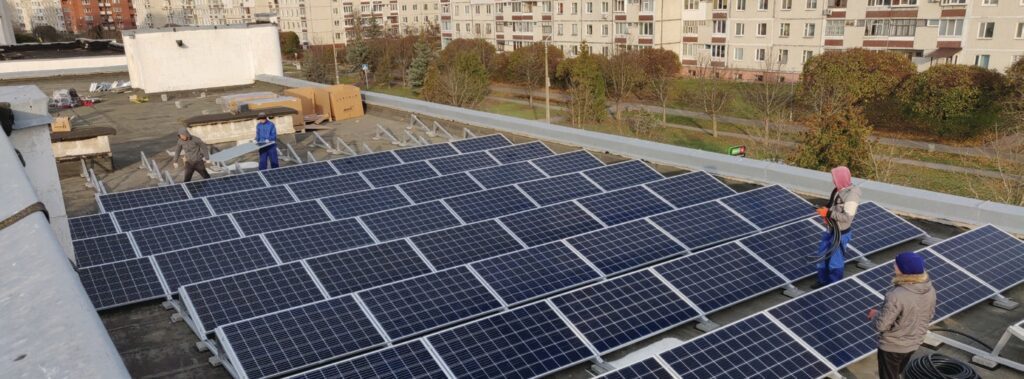
With the mayor’s support, Andrij and his friends built up Sonyachne Misto (Solar Town), a solar cooperative in the city of nuclear engineers. Solar Town demonstrates how energy
Building up Sonyachne Misto, Solar Town in the city of Slavutych. © Solar Town Project innovations can benefit the community thanks to energy-saving, local renewables, easier grid connection procedures and education programs for other communities.
The cooperative was registered in 2018 as the first of its kind in Ukraine. Now, it unites 97 members who own three solar plants. Every shareholder starts with an investment of at least €500, and every €1,000 invested brings an annual return of about €130 until 2030. This makes investing attractive for a broad range of people, not just the wealthy.
Andrij is clear about their target audience. “People from the area could invest first. We are proud that the first investor is a local woman, an energy manager, and two of our largest shareholders are in their twenties.”
He insists that Solar Town is not just commercial, but a project with great social impacts. “Solar Town gives away 5% of its annual income for city development. This is an integral part of its statute and philosophy. We believe in giving back to the community.”
The key to success
The team of Solar Town, with the help of local engineers, successfully completed the construction of all three planned solar power plants, raising €145,000 in just four months, and getting ready to finally launch the project. The key to their success? “A good financial plan, a legal model, permission from the local provider, and support from the mayor and the community. The most important factor is transparency: we show all our plans to everyone and answer every question openly.”
While Andrij put a critical amount of energy into that project over the past few years, the mission to create a flourishing community with a future-proof energy model continues to motivate him. Solar Town is an example of people overcoming challenges to build something big together. The community reinvented the city, empowering themselves to create a new future.
“We don’t want to stop here in Slavutych. We need to scale up small cooperatives. We want to show Ukrainians how to crowd-fund and initiate projects, sharing our practice of transparency and our experiences. We want to make this success available to as many people as possible.”