Community energy: A practical guide to reclaiming power
The Life of Your Group
Outreach to the wider community
Even though it seems very obvious, a community energy group needs to reach out to its community. Make sure these efforts are consistent, remember our communities are diverse, and make sure you are reaching out to different parts of your community, not just those the dominant spaces.
There are several things you need to consider when communicating the benefits of community energy to people, including your language, tone and approach. Think about how these will be received by different parts of your community, such as people who are older, or maybe speak other languages.
Community work is listening work
Being involved in a community project means becoming a very good listener. You should be present in your community often, observing and learning. To understand the issues that affect members of the community, get to know people and listen to them. Take the time to listen to their stories, about themselves and their communities.
Develop your listening skills and your trust skills. If you want to understand what makes people happy, worried, inspired or proud, you need to be skilled at the art of relaxed, informal conversations that build empathy and trust. This will allow you to deeply understand the bigger issues that are affecting people’s lives.
Spontaneous conversations in the community happen everywhere — in food markets, shops, on buses and trains, at the hairdressers, in cafés, supermarkets, schools and community centres. Go to these places and listen. Recognise what the common themes are, and link them to your own story about energy, climate and local economy.
Write a list for yourself of “listening spaces” in your community, and what you see as the common themes of the community. You can learn more about a community development approach to these kinds of stories in the book “Community Development in Action” by Margaret Ledwith.
Another important element is reflecting on who you might like to involve in your project. There are people in every community caring for others and empowering others. When you meet them, consider involving them in your energy project, or think about what you could learn from them.
-
From brainstorm to online platform: OurPower
 More info
Austria
It all started with three friends, Ulfert, Norbert and Peter, who had always been fascinated by renewable energy and its potential for the future.In February 2018, Ursula joined their circle, and they brainstormed on ways to bring energy closer to people to achieve the energy transition. An idea was born: an online marketplace connecting people interested in green local electricity. The group’s expertise, motivation and contacts across Austria helped them create OurPower in 2018.
OurPower, Austria’s first energy cooperative, kicked off with 19 people eager to be the energy transition. Envisioning a place where energy producers and consumers could meet and exchange, they developed the concept of an online platform. After presenting the idea at a member meeting, they discussed and tested the concept until everyone was satisfied. To make the process as participative as possible, they used innovative methods like “thinking aloud”, where people in front of their computers give oral feedback which is immediately recorded and implemented.
OurPower’s platform allows producers to sell their renewable energy directly to friends and neighbours for a fair price. Everyone interested can find out in 3 clicks where their energy is coming from and where their money goes. Ursula explains: “We want to connect people and bring energy as close as possible to them. Energy should not be a dry, technical issue. It’s a social issue, about connecting lives, making choices and our well-being.”
Ursula’s dream came true. An expert on online platforms and participation, she can now implement the concept technically and visually with her partners. Her goal is to encourage people to exchange their thoughts and ideas to achieve the energy transition, online, but also in person. Throughout the pandemic, OurPower has been organising webinars and online dialogues to discuss emerging topics with interested people, to strengthen relationships. “The most inspiring thing is to create change. You can’t do it alone, but if you have a trusted, focused, team who know each other well, you can change the energy system together.”
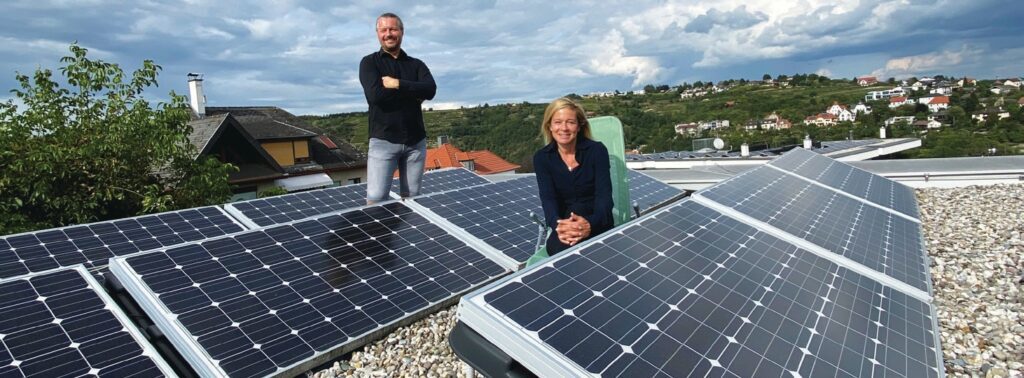
Peter, one of the OurPower founders, and Kathi on their solar rooftop. © OurPower Reaching out to the community for an inclusive energy transition
Ursula put a lot of thinking into OurPower’s target audience and ways of reaching them. First, the cooperative hosted several events to inform people and motivate them to take part in the energy transition. They also launched surveys, created 8 personae (fictional representatives of actual users of the platform), and discussed their target group’s lifestyles, preferences, opinions and resources.
While OurPower encourages everyone to join, the surveys revealed that they mainly reach people who have college degrees, a steady income, a family and are home- owners. A good start, but OurPower is now focusing on building a more diverse audience, to include women and young people especially. As Ursula says, “Young people are really important for us. We want to build up better relationships with them and understand their needs. We want to learn from them and respond to their questions. One idea we have currently is a pub-quiz on climate and energy issues.”
Community energy in times of a pandemic
What’s next? OurPower wants to make the platform more dynamic and participatory, and adapt to current technological developments. Ursula would like to enable more energy communities to share their knowledge, raise awareness and communicate publicly, to build up relationships of trust between diverse people. While the cooperative will continue to connect people and support them in producing renewable energy for each other, they also want to work more on people’s energy consumption patterns.
The Coronavirus health crisis has made their work more difficult. While many things can happen online, exchanging experiences and building up relationships remains a challenge. Since face-to-face meetings are difficult to organise and OurPower doesn’t want to bombard their clients with emails, they call people individually. A new idea to strengthen the community are pop-up spaces, offering potential new members a Corona- safe environment to meet up individually or in small groups, to get to know OurPower.

-
Vision workshop is Krizanc
More info
Croatia
One great way to reach out to the wider community is to hold a larger participatory workshop, bringing the community together to create a shared vision to develop their neighbourhood. In Krizevci (Croatia), this approach helped set up an energy community in collaboration with the mayor of the city, with the support of the Croatian energy cooperative ZEZ. A number of ZEZ-members were living in Krizevci at the time, or were from Krizevci originally, so they knew the local context and people in their community.
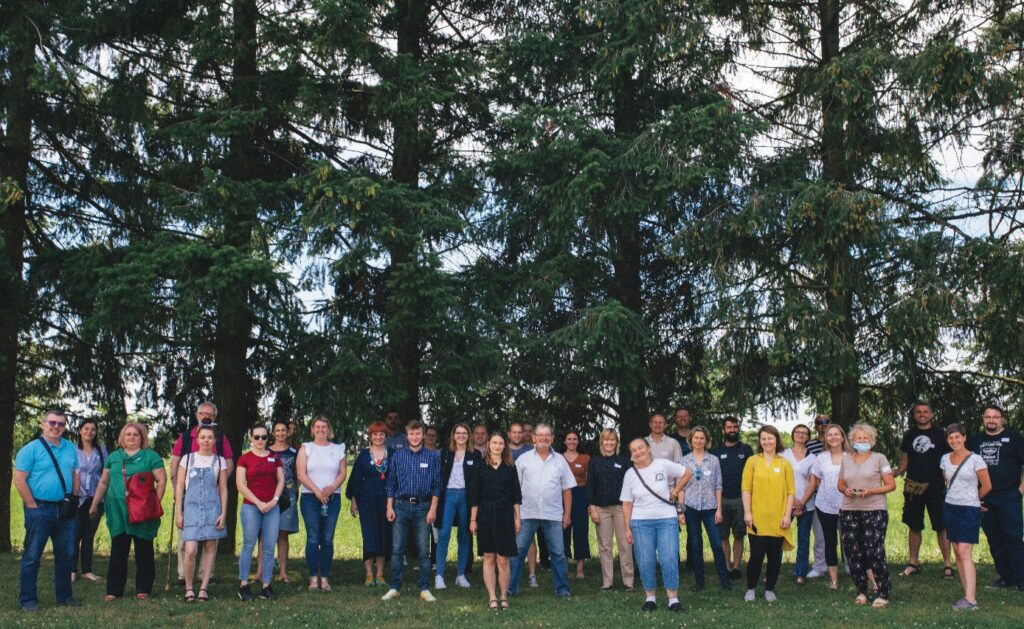
Workshop participants “Križevci 2030- Let’s plan the joint development of Križevci in the next 10 years”, July 2020. © ZEZ The first thing ZEZ did was to talk to people in the city informally, to see if there was an interest in setting up an energy community. Once they felt they had a good group of interested individuals, they organised a workshop over two evenings, from 7:00 to 9:00 PM to accommodate people’s work and family schedules, to bring all interested people together and talk about their ideas for an energy community.
In the case of Krizevci, people were already well informed about the subject. The city had participated in an EU project which set up a collective self-consumption scheme on an old industrial building, working with local SMEs and the municipality. The community understood the concept, and knew it could work.
The first meeting included a vision board, where the group formulated their objectives. From there, they worked back to the present, outlining milestones to reach their objective and specific actions needed. At the end of the first evening, the group had an outline for their statutes and a mission statement.
The second session was used to determine what legal form would be most appropriate for the community project, and what economic and governance model they wanted to choose. This included questions like the cost of a share, how many shares you needed to acquire at minimum, or the voting weight per person.
The people in Krizevci eventually decided on a cooperative, which would receive substantial support from the municipality but remain independent from it. The second evening ended with a first vote by the group to create the cooperative: all twelve workshop participants unanimously agreed. ZEZ then supported the group with writing the statutes and setting up the cooperative legally.
In terms of funding, the most effective method in Croatia for community projects is crowdfunding. In the case of Krizevci, the cooperative organised the crowdfunding campaign, with ZEZ supporting the administration of the funds. The communications campaign was key to engage citizens: ZEZ used their own communications channels, ensuring a wide reach by activating their audience.