Community energy: A practical guide to reclaiming power
Energy Revolution: it's up to us
The benefits of community energy

This chapter gives you an overview of the many benefits of community energy, showing how these projects benefit the energy system and society more widely.
1. Phasing out fossil fuels
Community-owned renewable energy projects significantly cut carbon emissions by replacing fossil fuels. Half of all European Union citizens could be producing their own electricity by 2050, meeting 45% of the EU’s energy demand. This would represent a massive shift away from polluting fuels that produce CO2 and destabilise the climate. When citizens are involved in the energy transition, support for renewables increases overall and the transition can proceed faster.
2. Cutting energy consumption
Many community energy projects aim to reduce the amount of energy being used, recognising that we must reduce our energy consumption to shift to renewables. Members of community energy projects are empowered to cut their energy use, through awareness-raising programs and investments in energy savings. In Brno in the Czech Republic, for example, an insulation-buying club offers training to residents, enabling them to cut the energy consumption of their apartment buildings.
3. Investments in clean energy
Transitioning to clean and safe energy generation will require huge levels of investment. Even though these investments are profitable, building an energy project requires large amounts of capital.
Millions of citizens across Europe have savings sitting in the bank that are unknowingly fuelling the climate crisis as banks and pensions invest in dirty energy projects. Getting communities involved in the energy transition can redirect this money to climate solutions and the local economy. Giving communities the chance to buy into schemes is an important way to make more money available for your project, and get people involved.
Finance is also covered in this manual as a challenge, because gathering the money needed can be difficult. But when communities overcome this initial difficulty, the project can leverage the finance needed to push the energy transition forward. For example in Germany, the famous Energiewende transition was pushed ahead mostly thanks to investments of farmers, communities and citizens.
4. Winning public support for renewables
Local opposition to energy projects can be a major barrier to renewables. Sometimes, it’s not difficult to understand why: too often, large scale developments are imposed on communities, with minimal opportunities for local residents to give input, voice their concerns, or take part. But when people are involved in the project, or even better, when they own it, acceptance and support can massively increase.
Various studies have shown higher levels of people’s trust in community energy projects. Public support for renewable energy in Denmark significantly increased with the development of wind-power cooperatives and the requirement for wind developers to sell shares to local citizens.
When people are involved in a project, they are much more likely to value its benefits and accept negative aspects. They are also empowered to mitigate negative effects, for example by carefully choosing where to place windmill sites in their local area.
Public support for renewables is linked to people’s levels of awareness. The more people know about energy issues, the more likely they are to support renewable technologies. To transition to a clean, safe energy system, people need to be engaged to become part of the solution.
Many community energy projects provide information and do outreach work, thereby increasing support in the overall population. Think about ways that you can include education in your project.
5. Tackling energy poverty
Many community-owned energy projects provide an allowance of electricity at low cost to the people involved. In the UK, many people who couldn’t afford their energy bills were placed on more expensive ‘pay-as-you go’ tariffs. Thanks to the Brixton Solar community project, local residents were instead provided with an amount of free electricity, generated by solar panels on their roofs. The project also provides ‘draught buster’ workshops to help people cut their energy consumption and bills.
When communities own the means to produce their own energy, they have more control over the costs, don’t have an incentive to overcharge people, and don’t demand higher prices like big energy companies. See more about Brixton Solar and Repowering London in the following text box.
6. Supporting your local economy
Community energy projects generate 2 to 8 times more local revenue than a project carried out by an external actor (as solar and wind power projects have shown). They create jobs, and can help create local energy markets where consumers can buy energy at a stable and fair price.
They can also boost European innovation. Because they are local, communities can support the emergence of a photovoltaic industry in Europe, as they are more likely to support a local or regional manufacturer of solar panels applying high social and environmental standards.
-
Repowering London
 More info
UK
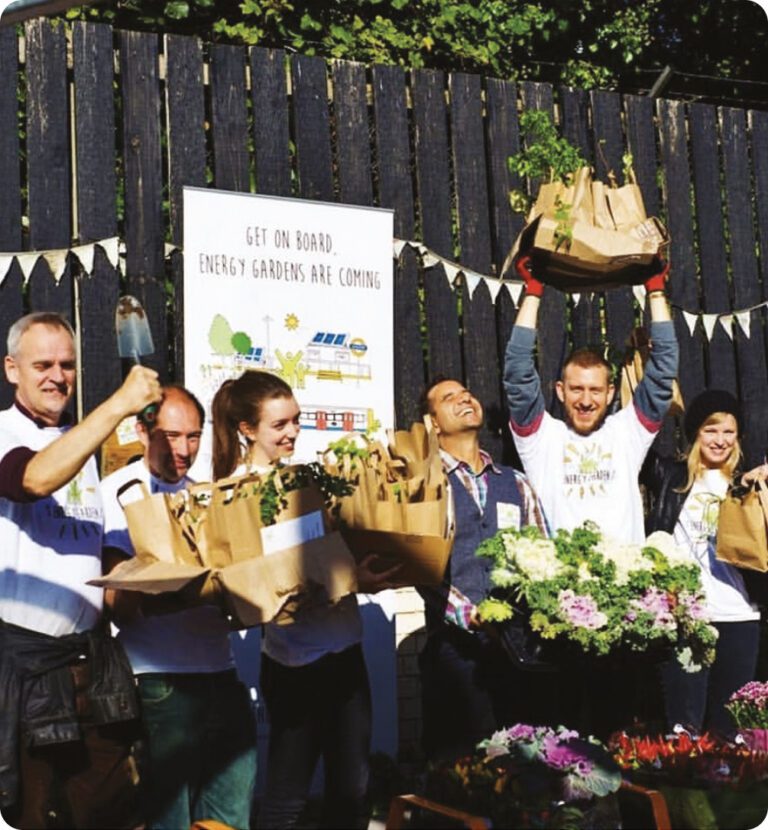
Repowering London is a non-profit organisation that was founded in 2013 by Afsheen Rashid and Agamemmnon Otero. The organisation came out of a volunteer group, with the aim of creating community energy projects on social housing; their first five projects are on social housing estates in London. The aim of Repowering London is to put power into Londoner’s hands rather than in the hands of big industry. Repowering London supports communities to create energy projects that generate renewable energy for the people and better futures for their community.
Repowering London sees the importance of nurturing co-operatives where community members have a say in which direction they want the projects to go. Establishing a democratic model is vital for the success of these community energy projects, as it empowers the community and sets an example of how community democracy can work. Local people can become cooperative members for £1 a month and this gives them a voting right in the decision-making processes of the co-operative. These decision-making processes encourage healthy collaborations between the communities, authorities and the public sector.
The £1 membership is about accessibility for Repowering London and their community members. The organisation installs solar panels on publicly owned buildings, and believe that everyone living in the borough should be able to have a say in how the projects are run, without having to invest hundreds of pounds. They have a one-member-one-vote system which means all members have the same ability to stand for a directorship, raise questions and decide how the community fund is spent (via voting at the AGM or becoming a director). The community fund is then used to support projects in the borough, allowing communities to identify their own solutions to problems and be supported to develop those solutions.
Repowering London takes pride in building the collective by hosting community events, such as a Greener Living Day. An event that welcomed community members to learn more about community energy and to meet more like-minded people who share the same vision. Similarly, Repowering London sends their community champions to schools and local community hubs to host workshops and talks about the exciting benefits of community energy. They also provide a flagship youth training program that is accredited and can be added to young people’s CVs.
How does Repowering make investing accessible for communities? The organisation wants to make the benefits of their projects as accessible and broad as possible. When holding a community share offer the minimum investment amount is reduced to £50 for those living in the borough and either on benefits or under 25 years old (rather than £100 minimum for anyone else). These amounts are as low as Repowering London can make them when admin and banking costs of the members are considered.
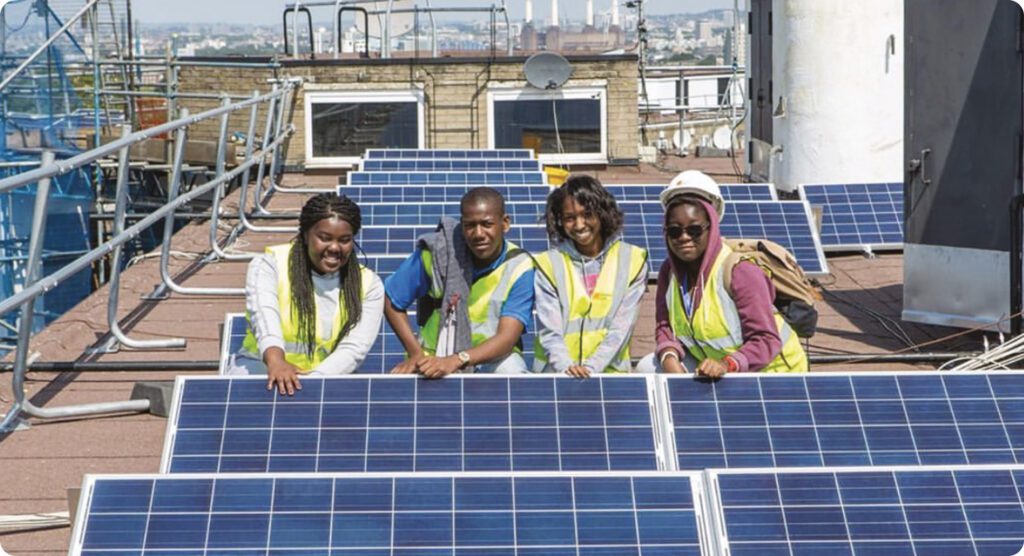
Youth Trainees from Brixton Energy Solar 2, Repowering Project. © Repowering London “By creating these projects, we can change the narrative around energy, community and what life can look like. We try to support as many people as possible by sharing this narrative, and the more people we work with, the more they tell our stories. The thing is about stories, the more often they’re told, the truer they become. Hopefully one day we don’t have to tell the story as the narrative becomes the world we’re all living in.”
DAVE FULLER, ROOFTOP PROJECTS MANAGER OF REPOWERING LONDON.
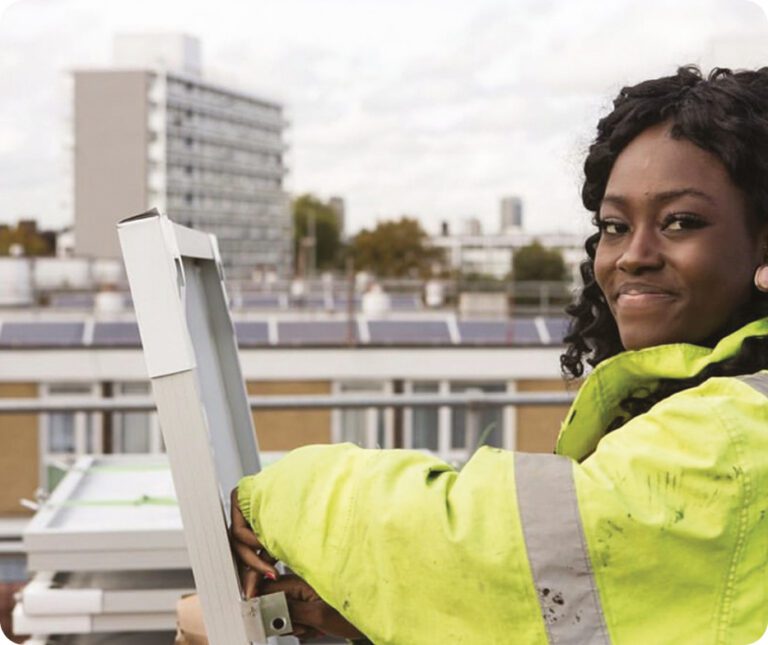
One of the youth traineees from Brixton Energy Solar 2, Repowering Project. © Repowering London THIS PROJECT SHOWS US HOW MANY DIFFERENT BENEFITS ONE COMMUNITY ENERGY ORGANISATION CAN PROVIDE!
- Local people see solar panels as something accessible to them and support renewables.
- Financial support for Loughborough Community Centre helped by funding the delivery of 4,494 lunches to children.
- The project supports people in energy poverty by dedicating 20 % of the profits of Brixton solar to the Community Energy Savings Programme (CEEF). This programme directly assists members of the community in energy poverty, by renovating houses with better insulation, other energy efficiency improvements and education on energy saving behaviour.
- Repowering London trains young people within a socially vulnerable neighbourhood and turns them into energy experts. After being trained for several weeks of energy internship, the youngsters can give high quality energy advice, or develop RES projects themselves.

7. Stronger communities
Communities that embark on successful renewable energy projects together develop a sense of pride and confidence. People develop valuable skills, and strengthen relationships. Communities that have worked together on a clean energy project are more likely to set in motion other projects which also benefit their community.
8. Redistributing profits
Sharing the financial benefits of the project also strengthens communities, and many community energy projects have small funding schemes that distribute grants to local voluntary groups and clubs. For example, Wadebridge Renewable Energy Network (WREN) in the UK used to take a small fee for connecting buyers and suppliers, primarily for solar energy, with members deciding which local group would receive funding.
As government support for domestic roof-top solar energy diminished and then disappeared, this activity dried up and ceased. However, WREN was then well-placed to take on the administration of community funds of £70,000 per year derived from local commercial wind and solar farms, which are distributed to local not-for-profit and voluntary organisations through a network of local committees. Such financial schemes can reinvigorate communities economically and socially.