Community energy: A practical guide to reclaiming power
The Different Forms of Community Energy Projects
Clubs, trusts & other forms
Cooperatives are a solid legal form for democratically owning and running your energy project. However, they are not the only solution and other options are available for your project. In some countries, creating a cooperative is a long process and implies navigating a lot of administrative rules. Other forms can be an easier first step, and your group can evolve towards a cooperative later. It’s useful to check out what the legal requirements are in your country. For most of these below, you need a simple mission statement or constitution, but putting this together can be a useful step for your team anyway.
In Germany you might want to become a Verein (e.V.), to register as a club/ organisation, meaning you will have members instead of shareholders, and equity can only be acquired as interest free membership fees or subordinated loans. But in a club/association, idealistic activities must always be prioritised over business concerns.
Alternatively you can register as a limited liability company, either for profit (GmbH) or non-profit (gGmbH). This could be easier if your activities are varied. However, a GmbH makes it harder to directly involve citizens as opposed to shareholders, if you plan to collect equity beyond subordinated loans. The vast majority of citizen wind farms in Germany are in fact either cooperatives or limited partnerships (KG), with citizens as shareholders and limited company liability (GmbH) as the general partner. This collaboration forms an entity known as a GmbH & Co. KGs.
In Belgium, a non-profit association is called an asbl or vzw. This type of organisation is not motivated by profit, or has profit as a secondary motive. Profit can only be used for purposes that do not serve private interest, and cannot be directly or indirectly distributed to founders, members, directors or anyone else. The members, directors and supervisory directors are called to the general assembly of non-profit associations and the management are then legally obliged to answer questions during the general meeting.
In Ireland, choosing the appropriate legal form for a community energy group isn’t straightforward. Groups tend to be attracted to the cooperative model first, however Irish cooperative legislation dates from 1893, making them a more difficult vehicle for energy generation projects. Aran Islands Energy cooperative and Claremorris Energy cooperative are two good examples of organisations making it work.
Another option is a Limited Company, however this legal form only allows for 149 shareholders, which is restrictive when building a community-owned project, and does not enable a key aspect of community energy: the opportunity for many to join. Templederry wind farm was established as a limited company.
Many community and social enterprise organisations are established as Companies Limited by Guarantee (CLG’s). However this legal form does not have any shares or shareholders, and does not allow dividends to be paid. For this reason, investment in these companies are donations with no expectation of a return.
Public Limited Companies (PLC’s) are perhaps the most attractive legal form to establish a community energy project. In legal terms a PLC designates a limited liability company that has offered shares of stock to the general public, and the buyers of those shares have limited liability, and can be unlimited in number. They can also be established with bespoke memorandums and articles of association which can be written to include many of the principles of cooperatives with modern working conditions. There are no such companies yet established in Ireland.
In the UK and Scotland, there is a proud tradition of trusts. There are over 140 development trusts in Scotland alone, all set up to give their community a bigger say in the decisions that affect them through ownership or management of an asset, or through an active role in the overall development of their place.
Development trusts are community organisations which:
- are owned and managed by the local community,
- aim to regenerate the community sustainably, or address a range of economic, social, environmental and cultural issues within a community,
- are independent but seek to work in partnership with other private, public and other organisations such as charities,
- are not run for profit.

Unlike other countries, energy cooperatives in the UK are largely limited to generating income for their members by selling electricity. UK Community Benefit Societies (or Bencoms) emerged in a context where market structures made it very difficult for energy cooperatives to supply electricity to their members, as they were being penalised by the regulator for this.
Bencoms operate similarly to cooperatives (see Edinburgh Community Solar Cooperative), including the one-member- one-vote principle. However, Bencoms differ from cooperatives in that a portion of the profit generated must return to the local community. In other words, it must generate benefits beyond the membership, which may consist of a geographically dispersed community of interest. As such, Bencoms often make grants available for local development purposes, that range from energy efficiency measures to educational scholarships.
-
The Edinburgh community solar co-operative ECSC
 More info
Scotland
The Edinburgh Community Energy Co-operative Ltd was formed with the aim of giving Edinburgh’s residents a way to promote and develop renewable and low carbon energy production in the city. The founders looked into a lot of different possible legal vehicles for their project. What was important was that they could focus on delivering a large scale solar project to the city.The co-op that they formed in the end is called the Edinburgh Community Solar Co-operative (ECSC) and it is actually a bencom.
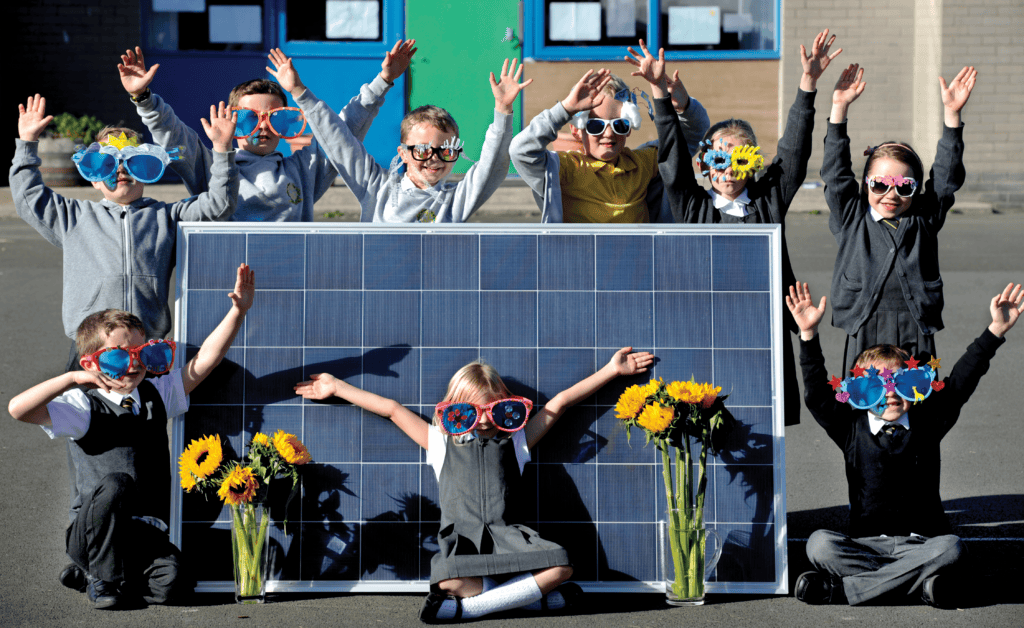
Primary School children celebrate the launch of Edinburgh Solar Coop © Edinburgh Solar Coop The cooperative launched a share offer in 2015 to raise funds to install solar panels on a number of council buildings throughout Edinburgh.They used the community share offer model, ordinary people from across Edinburgh were invited to become members of the project by purchasing shares of £250, the share offer was a success, raising £1.4 million in total.
At the time of the ECSC’s formation at the very end of 2013, Edinburgh had a lower number of solar panels compared to other cities across the UK. It was perceived that this was because many people lived in tenement flats with no access to the roof. Through the collective ownership of solar panels installed on community buildings, the ECSC offered Edinburgh residents a way of doing something positive about climate change, helping Edinburgh become a cleaner and greener city while also providing financial benefit to the residents and community as a whole. This was always the key thing, not what exact legal form the group took.
Today the cooperative continues to generate solar power from 24 host buildings in Edinburgh and return the profits to both their members directly and the community through their Community Benefit Fund which came into operation in 2018. They completed phase 2 with the installation of 6 more solar roofs.
The Edinburgh Community Solar co-op works closely with the local municipality. In 2012 the Edinburgh city council pledged to “encourage the development of community energy projects”. The community solar co-op was one of the first to take advantage of this commitment.

These different countries illustrate how several options often coexist, and how national contexts vary greatly. The main thing to remember is that legal structures provide the group with a recognised legal entity, independent from the individuals that form it, enabling greater accountability.
When you map out what’s happening in your community, keep an eye out for what kind of legal forms exist, what works in your area, and discuss the pros and cons of various forms with people with experience. In the end, keep in mind that the legal form is not the most important decision you’ll have to take — a structure is first and foremost a tool to achieve your aims.