Community energy: A practical guide to reclaiming power
The Different Forms of Community Energy Projects
Cooperatives

One very good option for energy projects is setting up a cooperative, a group of citizens that organise themselves to work together on a specific topic for the benefit of their community. Cooperatives can cover issues such as food, housing, transportation, finance — and energy. Many community energy projects across Europe are cooperatives, or REScoops (Renewable Energy Source Cooperatives).
When it comes to energy, cooperatives can take on many different activities (you will learn more about these activities later in this guide). When looking at cooperatives, it’s important to look at what they do, but also how and why they do it.
Firstly, the main objective of a cooperative is not to generate financial profits, but to improve the living conditions of their community. This doesn’t mean cooperatives don’t make profits, but the profits they make go either directly to their members, or are reinvested in projects that benefit the community’s natural, social or economic environment.
Secondly, a cooperative is organised in a democratic, open and transparent way. This relates both to the internal organisation and the financial decision making. For instance, members can decide how to use the cooperative’s profits, and how they want to set up and run their team. An important characteristic is also that all members have one vote, no matter how much they have invested. Together, these two characteristics distinguish cooperatives from traditional businesses.
-
Energy cooperatives take root
More info
Some of the oldest known cooperatives started in the UK around 1840, when a group of weavers organised themselves during a famine to jointly purchase food and make it available to the people in their community who were starving.
In Italy, several energy cooperatives were founded at the beginning of the 20th century in the Alps, working on hydro power due to the remoteness of rural areas and the lack of access to the main grid. As an example the SECAB, Societá Elettrica Cooperativa dell’Alto But was founded in 1911 and brought about many social benefits, such as free supplies of electricity, financial subsidies for charities and associations, and free professional training courses for young electricians.
Another example from the industrial era is the cooperative Vooruit, from Ghent (Belgium), formed by activists from socialist movements to prevent negative aspects of industrialisation, such as dangerous working conditions, malnutrition, poverty. The movement set up cooperative banks and supermarkets to cater to its community’s needs.
In some countries, the development of electricity included many cooperatives, for instance in Denmark or Germany where farmers and other rural communities organised power distribution in their area. In Germany more than 6,000 energy cooperatives brought electricity to rural areas.
Some energy cooperatives are more closely associated with one economic function such as consumption, production (making them similar to traditional cooperatives of consumers, workers or producers). Others combine different economic activities (production and consumption)
Some energy cooperatives offer the opportunity to choose between different hats, others impose restrictions.
- Some cooperatives require consumers to be members,
- Others offer the possibility to simply invest without using the services as a producer or a consumer, which can attract investors from outside the supplied area,
- Some cooperatives offer the opportunity to be a consumer without investing, which can broaden its customer base.
There are different ways to organise governance within a cooperative, and they usually revolve around the seven International Cooperative Alliance Principles (ICA), based on the Rochdale Principles. REScoop.eu, the European federation of citizen energy cooperatives has integrated the ICA principles in its Charter.
While a number of countries have developed legal forms for cooperatives in national legislation, the ICA principles can be integrated in any legal form beyond cooperatives (e.g. in founding statutes). More and more organisations establish their internal governance around these principles today.
One common challenge for cooperatives is that most of their members engage on a voluntary basis. This makes it even more important to ensure common understanding, shared values and goals, healthy communication and adequate workload distribution within the group.
The seven ICA principles of cooperatives
- Voluntary and open membership
- Democratic member control
- Member economic participation
- Autonomy and independence
- Education, training and information
- Cooperation among cooperatives
- Concern for community
-
The energy cooperative that built renewable energy for the masses: Ecopower
 More info
Belgium
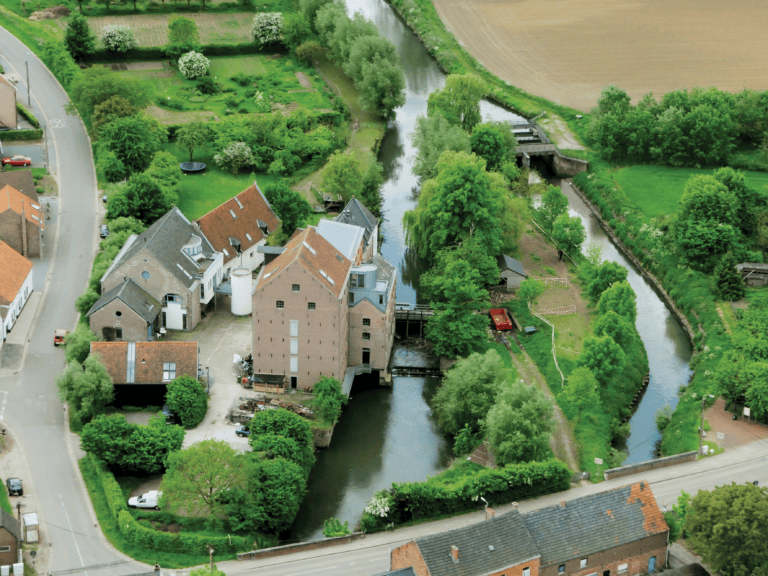
It all started around the small kitchen table of a co-housing project in an old watermill in the Flemish village of Rotselaar in Belgium, 30 years ago. Dirk Vansintjan, an activist for many years, realised that campaigning against nuclear energy was not what he wanted to spend all his energy on. He also wanted to be part of creating the solution.
The watermill in Rotselaar (BE), where Ecopower was born © Ecopower Looking at the old watermill, Dirk and fellow members of his community wondered, “What if we could get this to work again, and produce energy with it?” This is how the Ecopower cooperative started. Its first renewable electricity sparked in the 1990s, produced from the water turbine of that very watermill. Dirk still lives there today, a beautiful place that he shares with his family and friends.
Slowly but surely, the project became an energy cooperative, and the growing membership helped install new wind turbines and solar panels. Today, the cooperative powers more than 50,000 homes with 100% renewable energy.
Ecopower does not make a profit on its energy supply activities: all surplus is reinvested in new renewable energy and energy efficiency projects. All of the cooperative’s members can each buy up to a maximum of 20 shares, and each of the 60,000 members has one vote in the general assembly. If someone can’t financially afford a share, solutions are offered to potential members.
Today, the cooperative supplies roughly 1.64% of household electricity in Flanders with 23 wind turbines, 3 small hydro power installations, 1 co generation installation and 322 decentralised solar PV installations on the roofs of schools, public buildings and houses. Ecopower is saving energy too: it has helped its members halve their electricity consumption from the grid. Half of their members have installed PV panels on their roof.
By enabling citizens to own wind turbines, solar panels, small hydroelectric power stations and a pellet factory, Ecopower has seen support and acceptance for renewable energy increase.
Cooperation among cooperatives
In 2013, Ecopower co-founded REScoop.eu, the European federation of citizen energy cooperatives, now in 2023 a growing network of more than 2,250 European REScoops and their 1,500,000 citizens.
Ecopower has also been a pioneer in working with cities and municipalities like Eeklo, Ghent, Antwerp, Leuven, Beersel, …. They were one of the first energy cooperatives to discover the potential of cooperatives and local governments collaborating.
Dirk believes that the cooperative model helps build an economy that serves people and society, with ecological and social impact prioritised over profit.
“In the past two decades in western Europe, we’ve seen a wave of grassroots initiatives, citizens taking action, to seize the opportunity of the energy transition – from fossil and nuclear energy to renewables, from centralised to decentralised, from wasting energy to rational energy use. This is a unique opportunity for citizens to become active in the energy production and distribution of the future.”

Staying the course
Cooperatives have proved to be some of the most stable forms of community energy projects because people bring passion to these projects. You might stay in a job even if some aspects of it displease you, but often, the main thing keeping you engaged in a voluntary activity is motivation. This depends a lot on how you feel in the group, and that’s why it’s crucial to put time and effort into establishing healthy group dynamics. More on this in chapter 9, keep reading! And get cooperating!