Community energy: A practical guide to reclaiming power
Choosing Your Technology
Wind
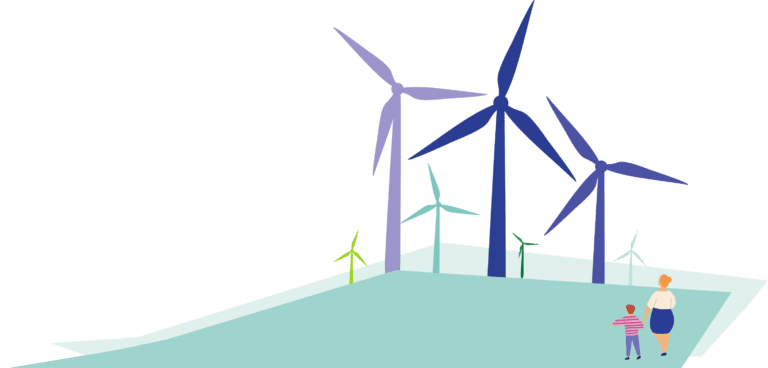
“The wind blows for everyone, not just for companies”, the Ecopower cooperative announced to the local municipality in 2016. Harnessing this energy gives local residents the opportunity to transform their energy system and improve their communities. Wind is a big part of the energy pie, don’t let big companies monopolise it!
Why wind?
A wind park can produce a significant amount of energy, more than solar panels for example. An average onshore wind turbine can produce more than 6 million kWh in a year – supply 1,500 households with electricity. Wind can be an important tool to replace fossil fuels that destabilise our climate.
Wind can also generate significant income that can be used to support your community, directly through sharing profits, and indirectly as it creates added value in the local economy.
When thinking about wind, consider your surroundings. Does the geography in your local area suit wind? Do legal rules support or block the project, or make it unprofitable? How would you transport a turbine to your region? These are the questions to start looking for the answers to out before deciding if wind is your technology of choice.
These questions are easier to answer once you identify potential land, and commission a detailed study into technology options with the assistance of a consultant if needed. In most countries, maps of wind speeds can help you understand how feasible a turbine would be an area. It’s also important to note that turbines are often forbidden close to military bases, airports or gas pipelines.
Public support
The key to getting public support for wind energy is to turn up with a blank piece of paper and let the local community build their vision themselves. Get the residents to meet with experts, provide best case examples, answer questions, but don’t come with a fixed plan: that’s the quickest way to lose their trust. Be flexible! Building support takes time but as shown in Eeklo below, plans made with real citizen participation can lead to successful permits without major objections.
Onshore wind farms are often called eyesores, with people complaining they ruin natural landscapes. However, it’s interesting to see how people can grow to like their appearance when the profits are shared in the community. It’s only natural people resist turbines when they are imposed on them without gain!
-
Wind against energy poverty: Eeklo
 More info
Belgium
The wind is a common resource and should be for everyone. In Eeklo (Belgium) the Ecopower cooperative shares ownership of a wind turbine with the local authority. This type of public-civil cooperation has great potential: elected officials have a stake in benefitting from wind, while the energy cooperative provides technical know-how, reflects the voice of the citizen directly, and involves vulnerable groups.
The Eeklo project started slowly, to consult people and make sure there was real support from the local community. The city is now trying to involve families in energy poverty, often people with a budget meter who are actually paying a high electricity price. Eeklo now considers to provide 750 people with a pre-financed share of the citizen energy cooperative, based on its 25% ownership of one wind turbine. By doing so these people get all the advantages of full members of Ecopower who co-own the wind turbine and can use electricity at cost, lowering their energy bills and allowing them to pay off energy debts. These members can also save up the cost of an own share (250€) in the cooperative with the savings they make on their energy bill.
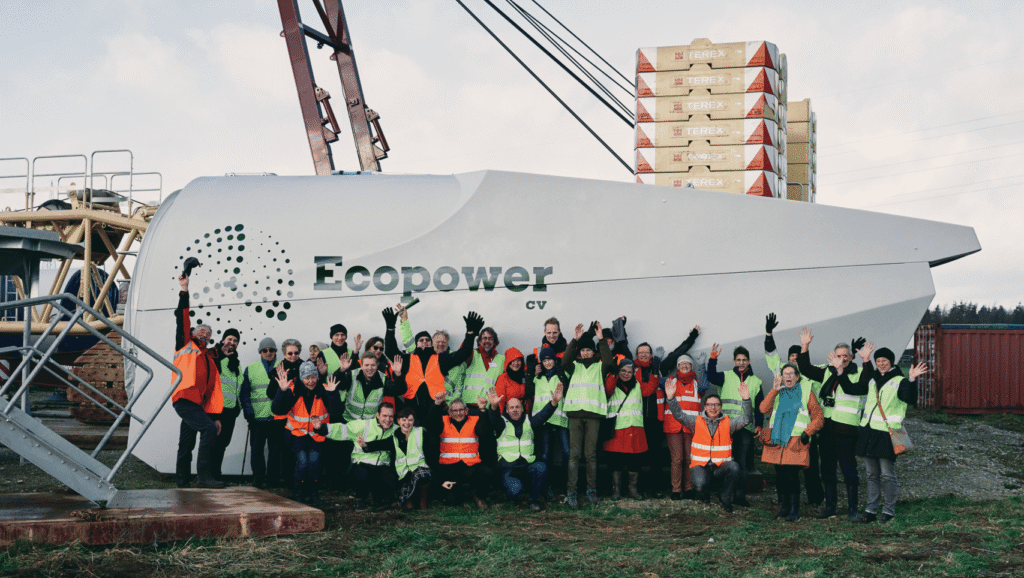
Members of Ecopower stand in front of the windturbine generator that will be built in Eeklo. © Ecopower cv Community workers from local social services will then support the energy poor families with guidance and budget management at the same time, to reduce the risk of non-payment for the cooperative.
The initiative shows how you can involve people who struggle with energy bills, providing them with access to renewable and affordable electricity without having to buy a cooperative share worth €250. Without the risk of social stigma, people can become full members of the energy community and pay the cost of the share as they save.
The cooperative and the municipality in Eeklo are also cooperating on heat supply, as the city commissioned the construction of a district heating network based on waste heat and renewables. When the city issued a tender for the construction of a large district heating network, it required a 100% renewable energy target and a minimum of 30% citizen ownership. The winning consortium managed to guarantee this through a partnership with Ecopower, to make heat sustainable and affordable for everyone.

Public consultation is not just a means to get permission to start a renewable energy project, it’s a chance to harness the knowledge and skills of the community. Residents will come up with ideas, questions, problems and concerns that you would never have thought of alone. Discussions will help you create a strong plan, while building trust and a future base for fundraising. It can also help you identify leaders in the community that you can ask to join your project.
Finding land
The average lifespan of a wind turbine is 20 to 25 years, so you’ll have to plan ahead! It’s very unlikely the community will be able to own the land, which is why most cooperatives rent space in a farmer’s field. However, be careful: once a turbine is up and running, neighbouring farms may be too close to install their own and receive the same benefits. Building support also means making sure everyone shares the profits, which is why cooperatives often provide compensation to neighbouring farms.
Studying the whole region early is very important when looking for a site. A private company could have land they could rent, or the local authority could be willing to cooperate. Start by engaging with your local authority to discuss land use, there might be a local land use plan that you can study. Community energy projects involving the local municipality are usually the most successful.
Getting the skills you need
If at any stage you feel overwhelmed, remember, you are not the first person to build a community-owned turbine, many communities have done this before and have accumulated a lot of knowledge. Don’t hesitate to reach out for advice, especially if someone in your country has done this successfully, even if you just know someone who has tried! Map out local skills, and find people who have experience in energy, skills in project management, engineering or accounting.
Seek advice
Call someone and ask them for advice. Offer to buy lunch or a drink if you can. Sometimes, even if they don’t know the answer, talking it out can help you see solutions, or figure things out together. Of course, there’s no need to rely wholly on the local community! Check out if there are nearby community energy groups you could speak to for advice, or if your region has a federation that could provide support. And there is always REScoop.eu.