Community energy: A practical guide to reclaiming power
Choosing Your Technology
Sustainable heating and cooling sources

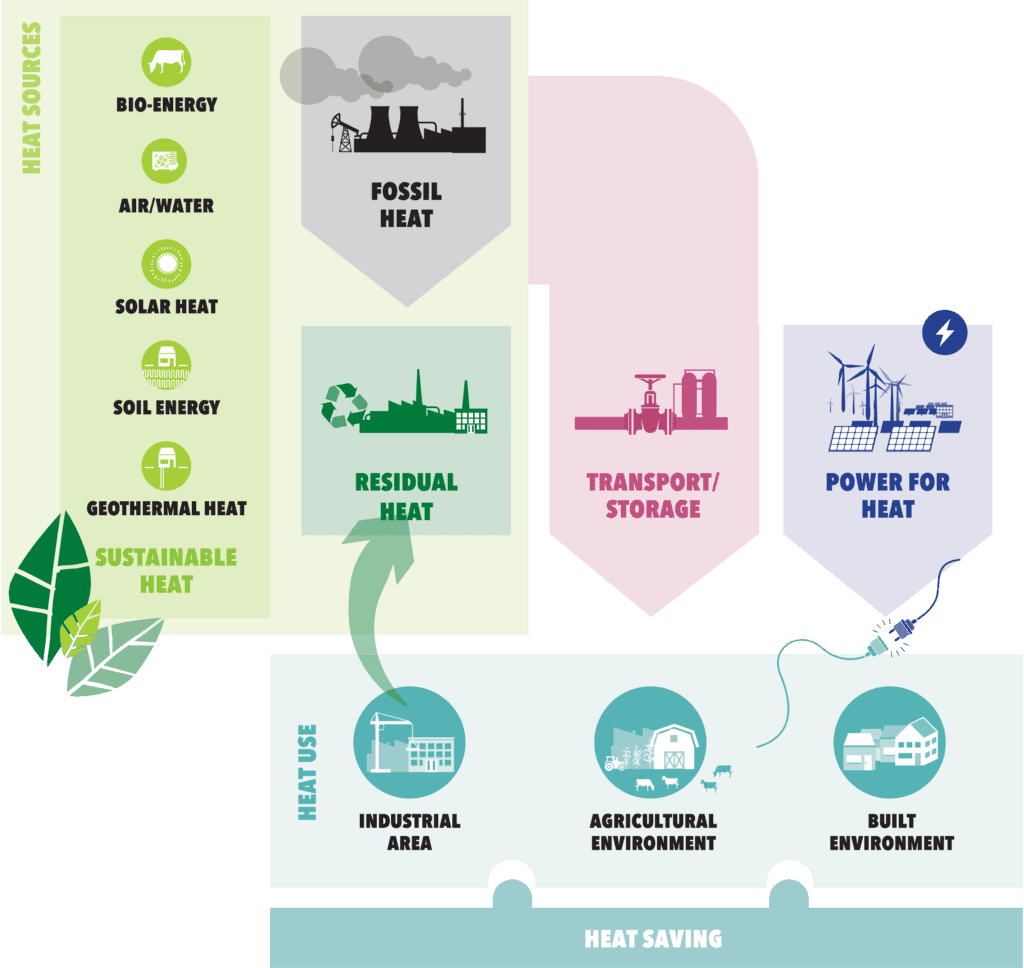
Apart from heating with biomass from residual flows or residual waste, residual heat from industry, power plants and servers, there are also other – sustainable – heat and cooling sources.
Geothermal energy
1) Deep geothermal energy
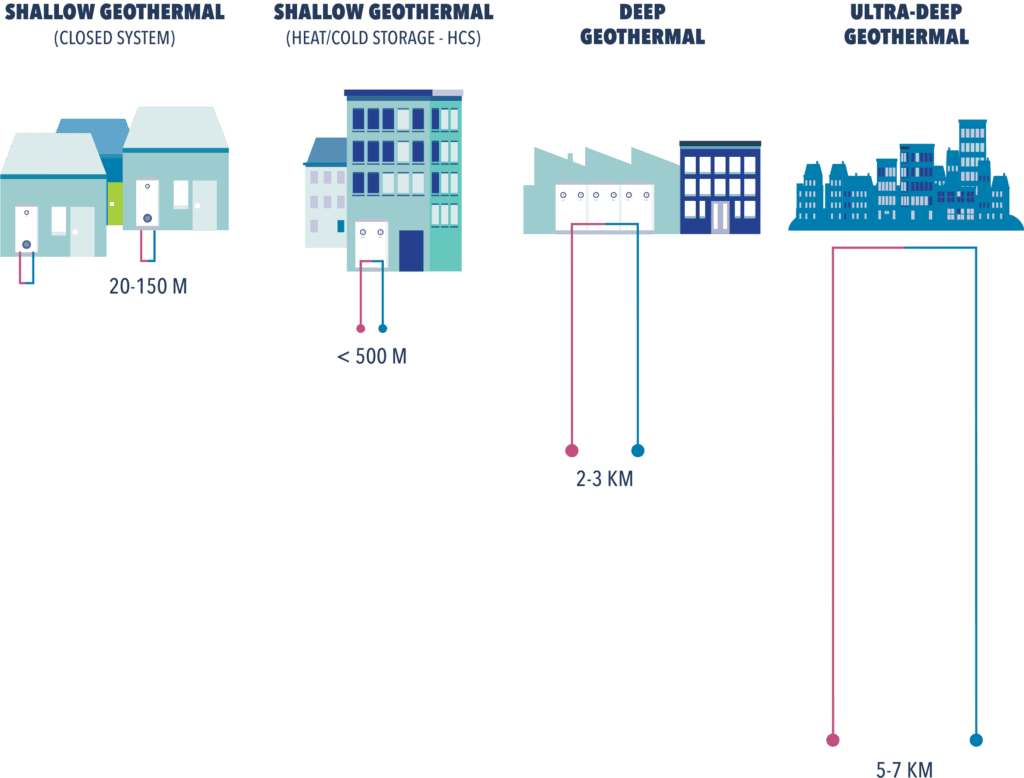
Geothermal energy is the use of heat from the deep subsurface (from 500 meters and deeper) for heating houses, buildings, greenhouses, and light industry. Whether geothermal energy is possible depends on the soil conditions and composition.
Between the geothermal source and the buildings, a heat network is needed with sufficient suitable heat consumers. A rule of thumb here is that there are about 4,000 houses needed. Depending on the depth, geothermal energy can directly supply a heat network with heat with a
temperature of approximately 70-90 °C. In the Netherlands e.g. geothermal energy currently is mainly used in the greenhouse horticulture sector. There are also projects in development for the built environment.
2) Shallow geothermal energy and storge of heat and cold
Geothermal energy is the use of the soil to extract and store heat and cold. It is a future-proof solution for making homes and buildings free of natural gas. One speaks of shallow geothermal energy up to a maximum depth of 500 meters. A heat pump upgrades the heat from the ground to a level that can be used by buildings. For individual buildings this can be done with a so-called bottom loop; for large buildings or clusters of buildings this can be done with a heat and cold storage system or ATES (Aquifer Thermal Energy Storage). The heat used in the winter must be replenished in the summer. This can be done by cooling buildings in the summer, and by actively introducing heat into the soil.
Aquathermal energy
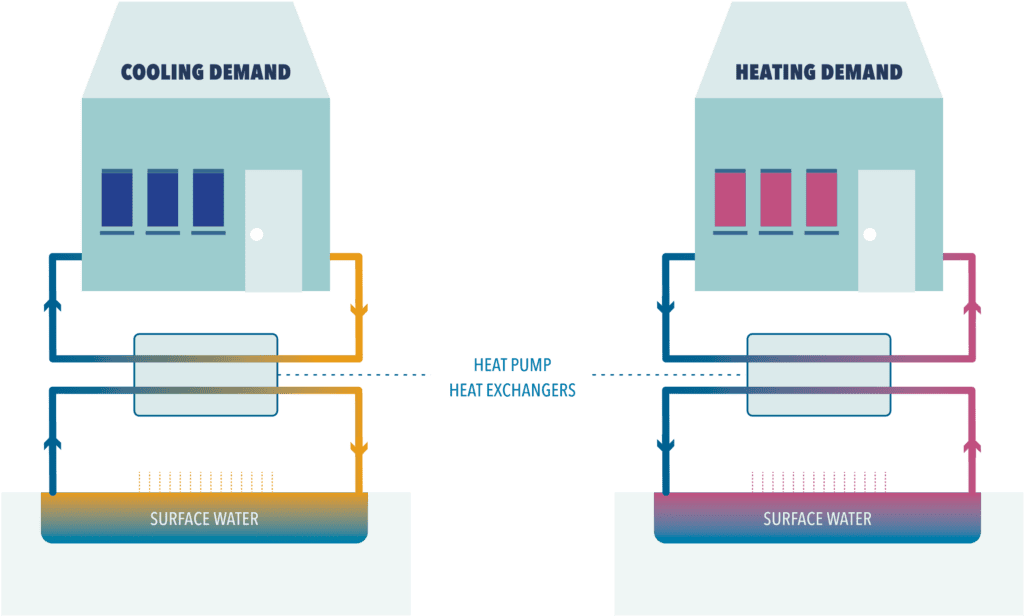
Aquathermal energy comprises the heating and cooling of buildings using heat and cold from surface water (TES), wastewater (TEW) or drinking water (TED). The heat from the water can be stored in the soil if necessary and then upgraded with a heat pump. This can be done centrally with a collective heat pump, or with a heat pump per building. A heat network is needed that transports cold, lukewarm, or hot water to the buildings. The financial and technical feasibility of a heat network with aquathermal energy depends on the proximity and size of the heat source, the need and possibilities of heat storage, the building density, and the degree of insulation of the buildings.
1) TES: thermal energy from surface water
With Thermal Energy from Surface Water (TES) you extract heat from surface water (the sea, a lake, pond, canal, stream, river, brook) with a heat exchanger in winter. An electrically driven heat pump ensures that the temperature is sufficiently raised to provide heating and domestic hot water in buildings. In many cases, the temperature of the surface water also allows you to cool the buildings in summer.
2) TEW: thermal energy from wastewater
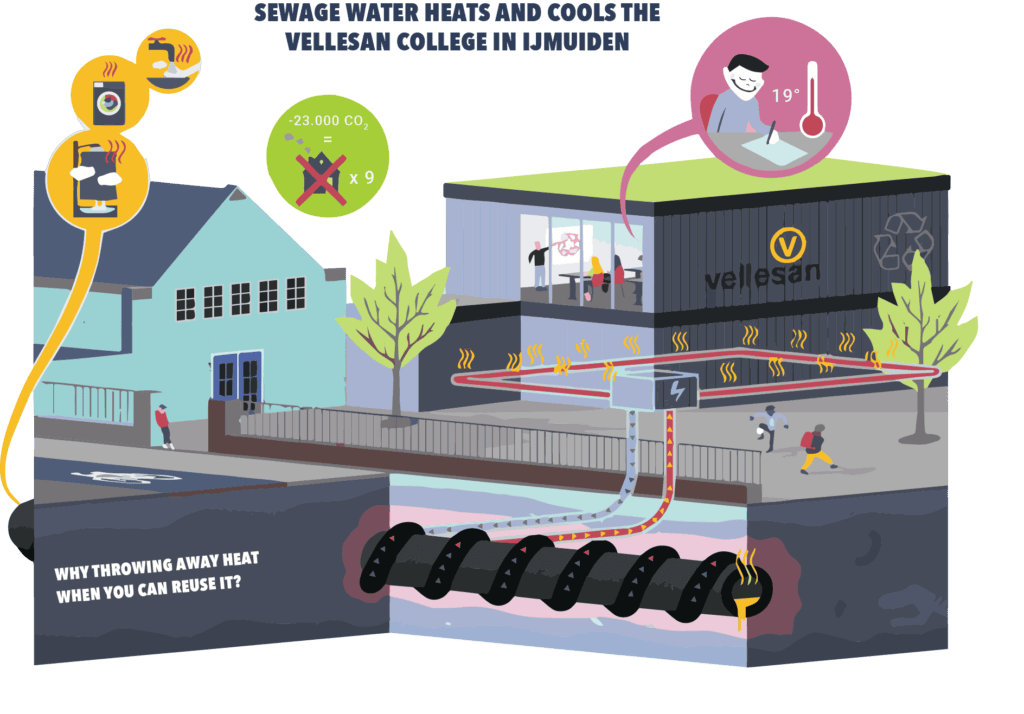
We can use energy from wastewater in the sewer for heating and cooling. This is sustainable, ecological and climate- friendly. A heat exchanger in the sewer captures the heat from the wastewater, which is upgraded by a heat pump to heat a building.
Sewage water has a temperature of 12 to 18° and is therefore a good source of energy. Recovery of this heat via heat pumps offers a lot of possibilities.
3) TED: thermal energy from drinking water
We can also use heat and cold from drinking water. From the drinking water pipe, heat or cold can be transferred via a heat exchanger for direct use or storage in the soil in a thermal energy storage system. The drinking water then flows back into the drinking water network.
Solar thermal energy
Everyone who already has a solar boiler and uses it to make sanitary hot water or to heat the house knows you can do a lot with solar heat.
But solar heat is also very useful in a heat network or for industrial processes.
If the temperature is too low, you can install a heat pump. Some solar collectors convert the sun’s rays into heat and electricity. This is done with so-called PVT panels. It is also best to combine these with a heat pump.
Large-scale solar heat projects often use a ground set-up. Sufficient space is needed for this, and the land should not be too expensive.
-
Collective district heating in Culemborg
 More info
The Netherland
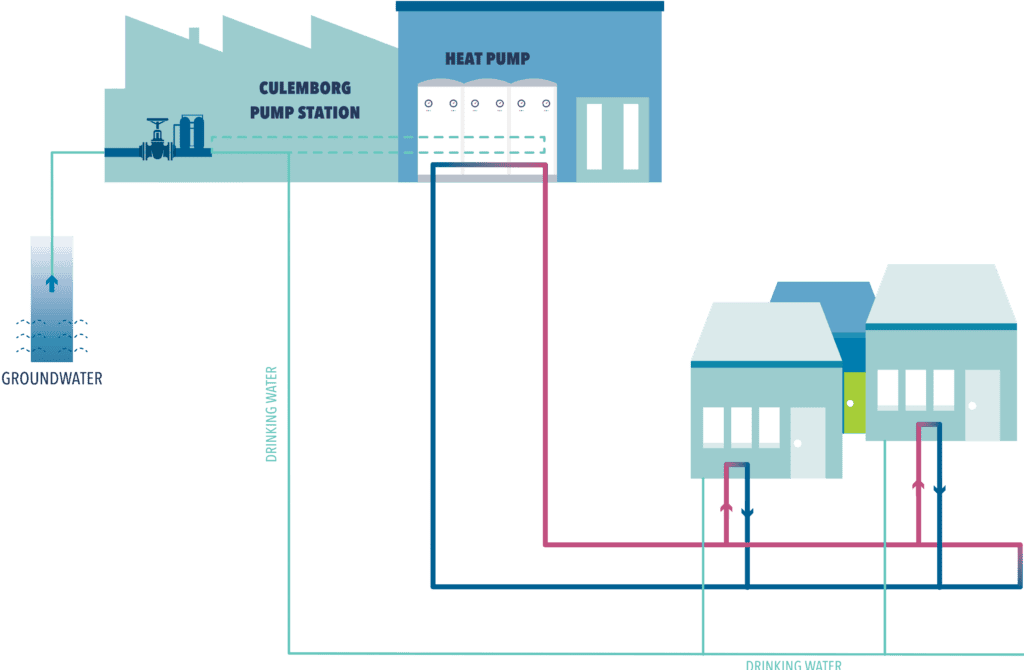
In the Dutch neighbourhood EVA-Lanxmeer, a collective district heating system was chosen with drinking water as the primary heat source. The drinking water supply in the Vitens water basin is cooled in winter to heat homes, apartments and utility buildings in the neighbourhood.
The heat is extracted in the heat station of Energy Company Thermo Bello, which is built against the clean water basin of Vitens. Thermo Bello is owned by the residents of the neighbourhood where the heat is supplied. Drinking water is continuously prepared in the basin. So there is always a supply of water available. Moreover, only a limited volume of drinking water is needed to generate heat. As a result, the water never cools down too much. However, the residents enjoy a comfortable warmth in winter, obtained in a sustainable and ecological way.
For more information see: www.thermobello.nl
Scheme of installation of Thermo Bello. © Thermo Bello.