Community energy: A practical guide to reclaiming power
Choosing Your Activity
Flexibility, self-consumption & storage
Beyond more traditional activities within the energy market, energy communities have been developing innovative solutions in the field of energy flexibility, such as storage, electro-mobility, and even blockchain technology. If you feel like your community would be interested in these areas, these examples are for you!
Collective self-consumption and storge
People often live in rented apartments and older terraced houses, making it difficult to install private solar panels. A collective solar project, led by the energy cooperative EnerGent (Belgium), has been looking for solutions to this. The project Buurzame Stroom intends to install 5,000 square metres of solar PV panels across a district in Gent, to increase renewable energy production in that district and set up an innovative business model for collective self-consumption.
One option is to unite people who own apartments in the same building to put solar panels on the roof. It can be challenging to work out a group agreement between all of the owners, to decide how they can share the energy, but once you develop a good model you can spread it in your city or district.
The project also wants to turn the district into an integrated local energy system powered by renewables. Electric vehicles operated by the cooperative Partago and battery systems were put in place to buffer excess solar energy for example. Buurzame Stroom also benefits from the expertise of various cooperatives, including Ecopower, EnergieID and the WiseGRID project.
Blockchain
Consumption or production data is often measured by metres, which are owned by distribution grid operators. This gives consumers little control over what is actually private and sensitive information. To solve this problem, the Pylon Network in Spain successfully developed an independent and neutral database based on blockchain technology. Through their technology, production and consumption data can be stored and shared safely. End- users or prosumers can keep control over their data and decide how they want to share their information.
Demand flexibility
In several countries, especially in northern Europe, the lack of electricity available to the grid (especially during long winter nights) is compensated by subsidised gas power plants. Energy communities offer a cheaper and greener alternative. Community members can make a flexibility offer, and accept to be limited in their electricity supply for a certain amount of hours per year, when needed, in return for financial compensation.
-
A wide partnership for an innovative collective energy sharing project: GECO
 More info
Italy
The Agrifood Centre of Bologna, CAAB, had solar generation installed with low rates of consumption and excess energy fed into the grid for low prices. Discussions on new EU laws in 2018 revived the idea of involving local businesses and citizens to create an energy community, and take advantage of energy surpluses to benefit the residents of social housing.
The same year, the Neighbourhood Economics Project, aiming to support sustainability investments in the area carried out preliminary studies on the idea. In 2019, CAAB and the Local Development Agency Pilastro North East partnered with local actors to push forward the initiative and discovered a similar initiative being explored by the ENEA in a nearby district, Roveri.
People decided to join forces to present the GECO (Green Energy COmmunity) project to the EIT Climate-KIC fund, to create an innovative local energy community involving both districts.
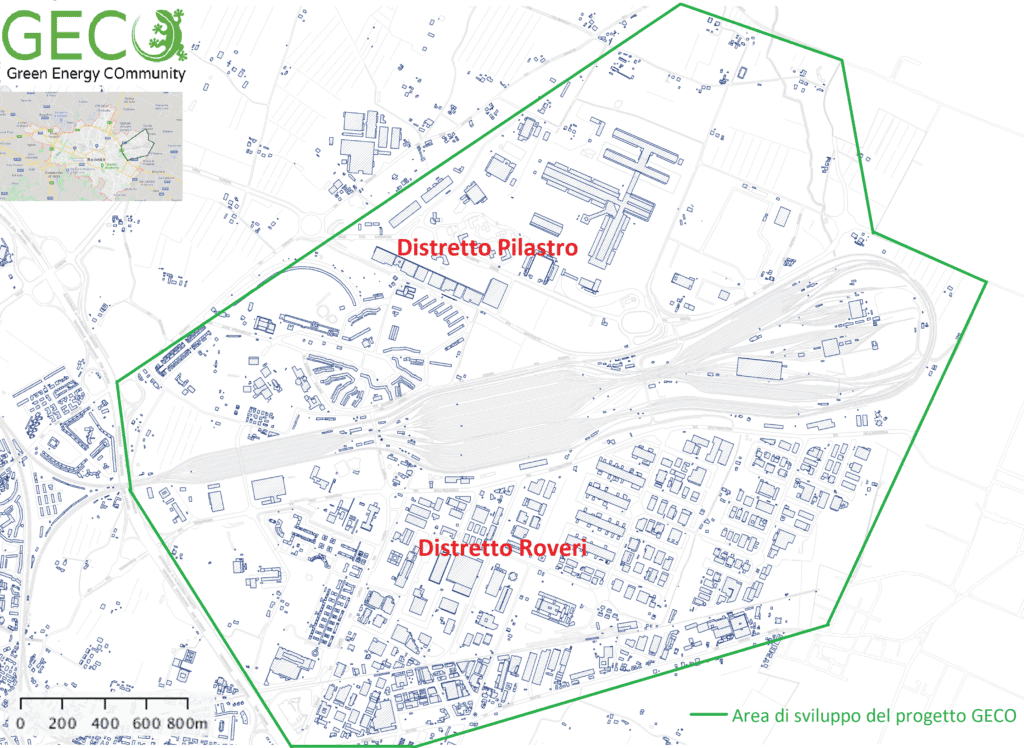
Map of the area covered by the GECO project. © GECO GECO is based on new systems using smart meters and a blockchain-based platform. Beyond solar installations, it includes biogas plants and storage to increase flexibility and demand response, and the system will be installed in commercial, industrial and residential buildings. GECO will use the public grid, creating a virtual community.
Currently, as full transposition of new EU community energy laws is pending, energy communities can only be formed by users that are on the same low tension feeder, for generation systems with a maximum capacity of 200kWin. In this first phase, GECO will rely on users to create small energy communities that later become part of the cluster entity. The idea is to enable efficient user behaviour since energy is shared with commercial and office buildings that mostly operate during the day.
Activities of the GECO project also include education and information activities with schools, associations and other local stakeholders, to raise awareness and support new prosumers in the area.