Community energy: A practical guide to reclaiming power
Choosing Your Activity
Energy savings & fighting energy poverty

Another important project for your group could be increasing energy savings and energy efficiency in your community. This is a great way to start activities and gain expertise and trust in the community, especially in the beginning.
Many people, especially in Southern and Eastern Europe, live in inefficient homes that waste heat in the winter. Precious energy is being lost through thin windows, walls and roofs, harming peoples’ health and wellbeing, and inflating our energy consumption.
Energy poverty is the manifestation of social inequality in energy consumption and inadequate access to energy services, due to a combination of low incomes, high energy prices and inefficient homes. It increased dramatically after the 2008 financial crisis, affecting millions, and leading to the creation of many European grassroots movements fighting for energy justice and against energy disconnections.
- Up to 1 in 4 Europeans live in energy poverty, representing 125 million people.
- In 2015, close to 50 million of people in the EU were late or unable to pay their utility bills. In Greece, this was more than 40% of the population.
- In 2015, 15% of Europeans were living in homes with a leaking roof, damp walls, floors or foundation, or rot in window frames of floor, representing close to 80 million people.
- Up to 100,000 Europeans a year die as a result of a cold home.
Energy poverty feeds into a vicious cycle of social exclusion. It harms the most vulnerable first: the elderly, low-income families, single-parent homes (80% headed by women) and people of colour. Despite this, only a third of EU governments officially recognise energy poverty. Even where there is recognition, many fail to make the connection with our energy system which drives over-consumption of fossil fuels and energy waste.
Community power initiatives can reach out to vulnerable and low-income households to:
- Invest in ownership to get cheaper access to renewables, so they can benefit from the collective wealth generated,
- Invest in energy efficiency measures and building renovations to improve living conditions,
- Learn how to reduce their energy consumption and bills.
You can start by identifying people in your community who are in energy poverty thanks to a door-to-door survey to meet them and talk about their homes. The survey could also help you get to know the area and people better. You could also organise a community meeting to speak with people about their ideas. Do they want to organise retro-fitting together to insulate their homes with available grant schemes?
- The energy poverty handbook from Housing Europe.
- Best practices - coops implementing energy efficiency.
- webpage with examples of energy cooperatives focusing on solidarity in Europe.
- Behavioral drivers for energy efficiency in REScoops.

-
Crew energy: Power at the grassroots
 More info
UK
CREW Energy was founded in 2014 by members of Friends of the Earth to take action against energy poverty, energy inefficiency and fossil fuels. Today, its main goal is helping communities across south-west London become environmentally and financially sustainable.
Its vision is a greener, fairer community for everyone, built from the grassroots. CREW Energy coordinates projects on energy transformation and hosts energy advice cafés to make residents more aware about energy efficiency.
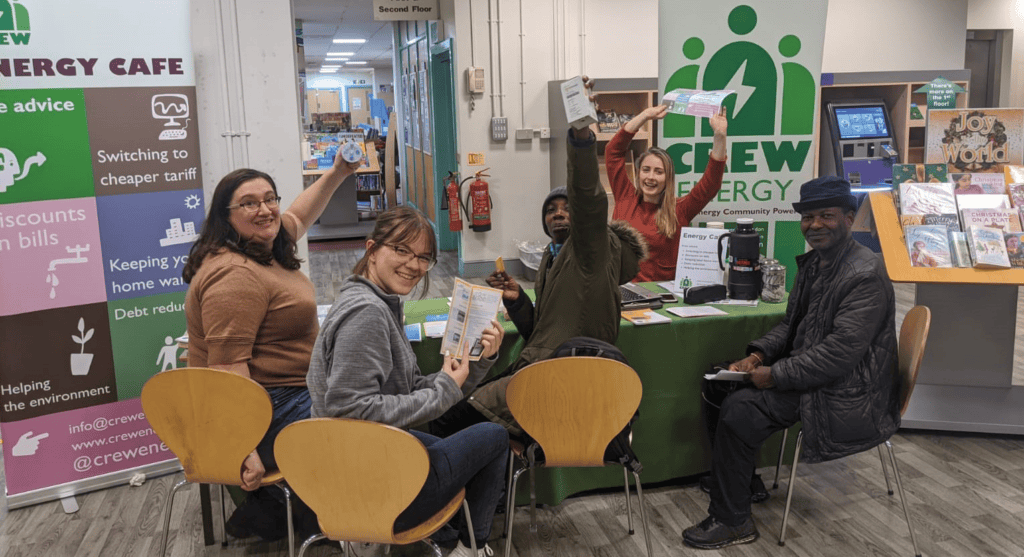
These regular exchanges take place in community hubs, where CREW Energy staff invite community members to discuss their role in energy efficiency while sharing tea and biscuits. In this welcoming setting, people can get advice on the best energy tariffs, additional benefits, grants and discounts on energy bills.
CREW’s Energy cafés aim to tackle energy poverty and support marginalised groups’ well-being: many communities, particularly those in socially and economically deprived areas, do not normally have access to such energy expertise. Thanks to these sessions, a resident saved £300 on their energy bills, showing how these spaces are needed and potentially life-changing for the community.
CREW Energy’s efforts to make their work sustainable has led them to educate and empower young people to pursue careers in the energy sector. Yunus Nas, a recent Environmental Science graduate who completed CREW’s Energy training to assess household efficiency, said, “Working with CREW Energy has given me the confidence and encouragement to implement my training to effect change on a local level. It’s a great way to deploy my skills and experience to help accelerate my community toward a more sustainable and environmentally friendly future.”
CREW Energy supporting young community energy champions. © CREW

-
Self consumption to fight energy poverty in Tuscany
More info
Italy
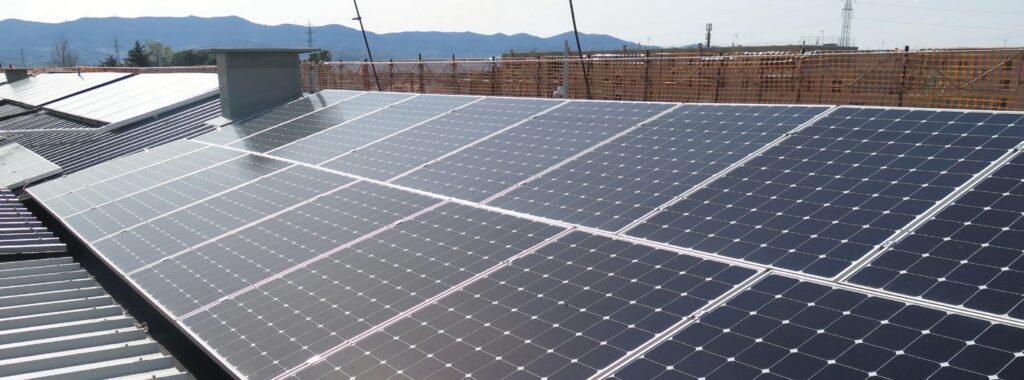
In 2019, the Italian social housing company “Edilizia Pubblica Pratese” inaugurated the NzeB residential complex in San Giusto (Prato) including 29 lodgings, a community centre of 250 square metres, an equipped garden and a new square. This project is a great example of collective self-consumption to fight energy poverty, combining high levels of energy efficiency with social housing to minimise energy costs, thanks to innovative approaches using sun and wind energy.
The energy produced in the building comes entirely from renewable sources, as well as 90% of the energy used for heating and hot water, and over 60% of the total energy consumed by the building, including condominium electricity consumption. The centralised system consists of a heat pump and produces 12,701 kWh/year. It is powered by 100 photovoltaic panels. Inside the building, heat is distributed through floor panels, and solar panels are used for heating and to produce hot water. Buildings are highly efficient, thanks to an insulated roof and advanced thermal systems, keeping families warm in winter and cool in the summer.
Installation of solar panels at the NZEB in Prato, Italy. © Studio Tecnico Associato RES Architetture