Community energy: A practical guide to reclaiming power
Choosing Your Activity
Supply
A number of energy communities have opted to operate as energy suppliers. There are different ways to do this: some produce their own electricity and sell it to their clients, and some buy and aggregate renewable energy from other producers for their members.
Coopérnico from Portugal is such an example of the first option. The country’s first cooperative supplier and producer invited citizens from all over the country to become members and purchase shares. These revenues were then used to finance renewable energy investments such as solar PV panels. The energy produced from these panels is supplied to its members and beyond.
Community Power is Ireland’s first, and only community-owned electricity supplier. The company grew out of the group that built Ireland’s first community- owned wind farm, Templederry, and is now a partnership of community energy groups seeking to develop renewable energy in their areas. The supplier buys renewable energy from small wind and hydro generators, and sells it to their customers. In 2020, the first renewable electricity auction was held in Ireland, including a category for community-owned generation. Following their success in this auction, Community Power will develop two citizen-owned solar parks.
A few years ago, the energy cooperatives from the French-speaking region of Belgium decided to join forces and set-up Cociter, their own cooperative energy supplier. The energy that the cooperatives jointly produce covers the needs of 15,000 families. With over 3,000 members, Cociter still has space for 12,000 new families to join.
As with electricity generation, becoming a cooperative energy supplier comes with its own challenges, linked to regulations, the influence of established market actors, and financial limitations, among others. Don’t despair if your community hits a roadblock of this sort! It’s completely normal, and with the help of other cooperatives, you’ll find a solution.
Cooperative energy suppliers
Across Europe the list of cooperative energy suppliers keeps on growing. If you don’t get your energy from one already, now is the time! ènostra from Italy has 11,000 clients, Enercoop from France has nearly 107,000 clients, Som Energia from Spain has 118,500 clients, Green Planet Energy (Germany) has over 214,000 clients, Ecopower (Flanders, Belgium) has 55,500 clients, and EWS (Germany) has over 200,000 clients.
- Entering the retail energy market: a guide. This is from the British regulator but has lots of information of general relevance.
- Understanding electricity markets in the EU.

-
How Enercoop found a way into the French energy market
 More info
France
When French environmental NGOs, energy experts, project developers and alternative financing companies set out to set up citizen-owned energy supplier Enercoop 15 years ago, the situation was less than favourable. At the time, all of France’s energy assets, its main utility company EDF and main distribution system operator ERDF were state-owned. Most of France’s electricity (75%) came from nuclear power – which is still the case today. The French government was very reluctant to liberalise its energy market at the time, which made it very difficult for any actor other than EDF to compete on the market. This prevented projects from having access to renewable energy production and thus being able to secure a viable model as a supplier in France. It is still difficult today but to a lesser extent – partially thanks to EU legislation. Initially, French law stipulated that any renewable energy produced had to be sold to the historical utility company if the owners wanted to receive feed-in tariffs from the government. So during its first years of activity, Enercoop had to buy its renewable energy from publicly owned hydropower installations.
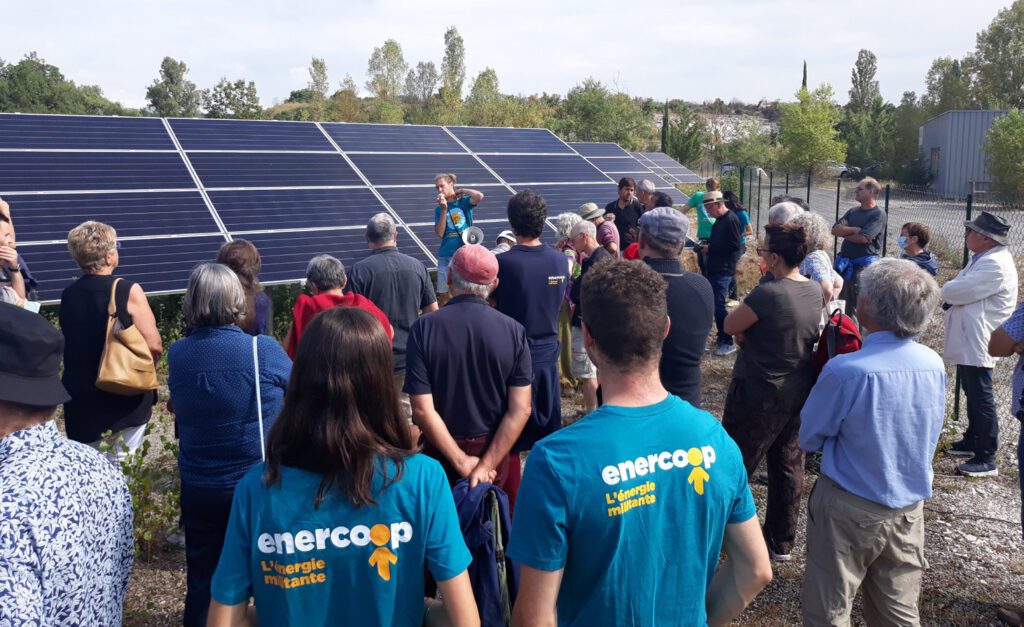
A local Enercoop group next to installed energy project © Enercoop Midi-Pyrénées To access this production, the public utility demanded a bank guarantee for the total amount of energy Enercoop would buy from them. At the time, Enercoop was not able to provide this guarantee on their own, and as a last resort, turned to the neighboring Belgian cooperative Ecopower for help. Together with the ethical bank Triodos, the French bank Credit Coopératif and Ecopower, they were able to provide the needed support. Enercoop never needed to claim this guarantee, but it was necessary to save the cooperative at a crucial time in its history.
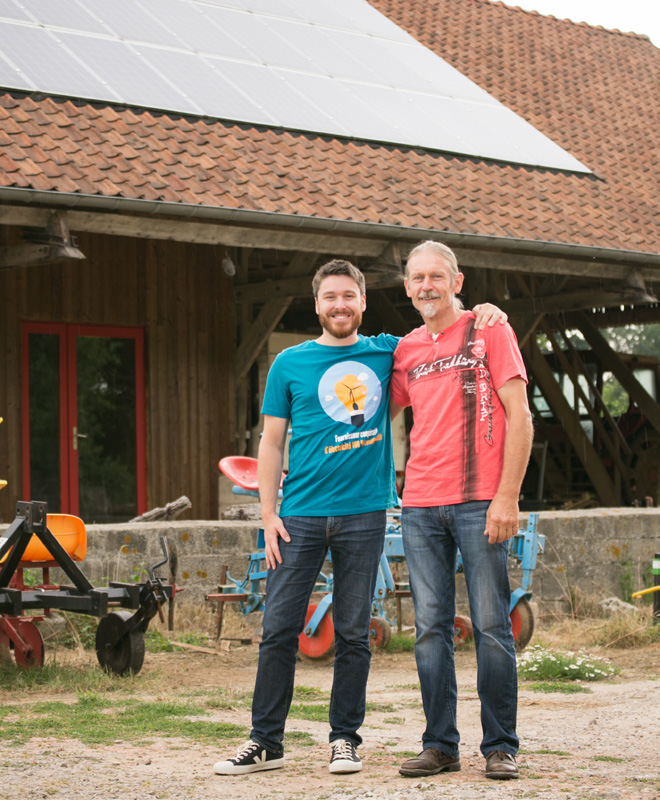
Citizen solar energy project in France. © Enercoop Today, after much advocacy on both national and EU levels, Enercoop can purchase its electricity directly from renewable energy producers, who continue to receive government support. Looking back, this difficult episode in the life of the French cooperative and the cooperation it led to with Ecopower is what started the idea of an EU-wide federation of energy cooperatives, “to help beginners and existing cooperatives overcome obstacles they face by learning from others.”